Get in your inbox the latest News and Offers from
- Office No. 564, Dubai Investment Park First, Dubai, UAE
 (1)_1768978360.png)
- Office Time:
- Business Hours (08:00 AM - 06:00 PM)
- Call Us:
- +971 502046279
- Email:
- contact@jmtsllc.ae
Capillary Action & The Sky-High Relay: Defying Gravity at 800 Meters
Capillary Action & The Sky-High Relay: Defying Gravity at 800 Meters
The Problem: Gravity is a Heavy Opponent
If you tried to pump water from the basement of the Burj Khalifa directly to the 160th floor in one go, the pressure at the bottom would be over 30 bars (roughly 450 psi).
The Risk: That much pressure would literally explode a standard steel pipe or cause it to "rocket" through the building.
The Challenge: How do you get 1,000,000 liters of water up there every single day without the pipes bursting?
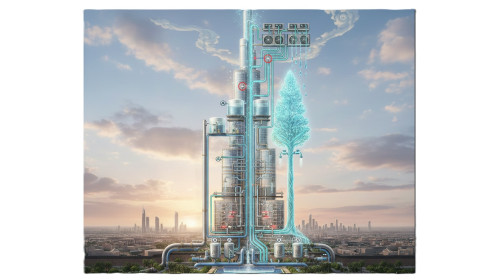
1. The "Forest" Strategy (Vertical Zones)
Engineers don't try to win the race in one sprint; they treat it like a Relay Race.
The Setup: The building is divided into several "Mechanical Zones" (staggered every 30 floors or so).
The Magic: Each zone has its own massive Holding Tank. A pump at the bottom sends water up to the first tank. Then, a new pump at that level takes the water and sends it to the next tank, and so on.
The Fact: The water "rests" at different heights, which resets the pressure to zero at every stage, keeping the pipes safe.
2. Capillary Action: The Tree Inspiration
In nature, a 100-meter Redwood tree pulls water from the dirt to its highest leaves using Capillary Action?the ability of a liquid to flow in narrow spaces without the help of, or even in opposition to, external forces like gravity.
The Engineering Magic: While the Burj uses pumps for the heavy lifting, the final distribution inside the apartments often mimics this natural flow. Engineers use "Small Diameter" piping networks that use the Surface Tension of water to ensure it flows smoothly into every tap, even at 800 meters.
3. The "Free" Water Secret: The Condensation Harvest
In a hot and humid place like Dubai, the air conditioning system has to work overtime.
The Fact: As the cold AC coils hit the hot Dubai air, they "sweat." This produces a massive amount of condensation water.
The Magic: Instead of letting this water drip away, engineers "catch" it. The Burj Khalifa collects about 15 million gallons of water per year just from the air.
The Result: That?s enough to fill 20 Olympic-sized swimming pools every year, which is then used to irrigate the beautiful parks and fountains at the base of the tower.
4. Pressure Management: The Downward Magic
Once the water reaches the top, engineers face a new problem: when you turn on a tap on the 50th floor, the water coming from the 100th floor wants to come out like a fire hose because of the weight of the water above it.
The Solution: Engineers install Pressure Reducing Valves (PRVs). These act like "brakes" for the water, slowing it down so it comes out of your sink at a gentle, safe speed.