Get in your inbox the latest News and Offers from
- Office No. 564, Dubai Investment Park First, Dubai, UAE
 (1)_1768978360.png)
- Office Time:
- Business Hours (08:00 AM - 06:00 PM)
- Call Us:
- +971 502046279
- Email:
- contact@jmtsllc.ae
The 100-Year Clock: Why Great Engineering Plans for the Generations We Will Never See
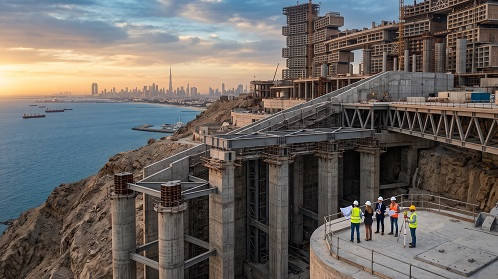
The 100-Year Clock: Why Great Engineering Plans for the Generations We Will Never See
When someone buys a smartphone, they expect it to last a few years. When a company builds a car, they design it to last a decade. But when engineers design massive buildings, foundations, or city pipelines, they are setting a 100-year clock.
Building something to last a century means planning for a future we will never see. It is the ultimate act of leaving a legacy ensuring that what we build today remains perfectly safe for our grandchildren's grandchildren.
The Magic Fact: The "Slow-Motion" Aging of Concrete
To the naked eye, a massive concrete wall looks like a solid, unmoving rock. But deep inside its microscopic pores, an invisible chemical process called carbonation is constantly ticking away like a slow clock.
Over decades, carbon dioxide from the air slowly seeps into the concrete. Very slowly just a few millimeters every ten years this air changes the chemistry of the wall.
The 100-Year Danger: Raw concrete naturally protects the steel rebar hidden inside it from rusting. But when that slow-moving air finally reaches the center of the wall decades from now, the protection vanishes. The hidden steel begins to rust, expand, and crack the building from the inside out.
Great engineers don't just build for today. They calculate exactly where that invisible chemical front will be in the year 2126. They use special chemical mixes and place the steel deep in the core just to delay a reaction that won't peak for generations.
1. Designing for Everyday Wear and Tear
A building rarely falls from one big storm; it usually wears down from millions of tiny everyday moments. Engineering for 100 years means knowing exactly which parts will face the most stress. While the heavy concrete bones are built to last a century, the smaller joints, seals, and pumps are engineered to be easily replaced every 20 years without shutting down the entire facility.
2. The Slow Shifting of the Earth
Under massive weight, materials change over time. If you put a heavy load on a concrete pillar, it doesn't just bend instantly it slowly deforms by tiny fractions of a millimeter over fifty years. At the same time, the heavy weight of a structure slowly squeezes the water out of the soil deep underground. Engineers must calculate this slow-motion settling from day one so the building doesn't tilt or crack decades later.
3. Engineering for a Changing Climate
How do you design a building's outer skin for weather you haven't experienced yet Century-scale engineering uses advanced predictive computer models. Whether it is preparing a steel frame to handle the intense expansion of hotter summers or calculating wind tolerances for unprecedented storms, the blueprints must be ready for weather patterns that don't even exist yet.
Anyone can build a structure that stands up for a day, a month, or a year. But building a system that runs safely and silently for a century requires a deep respect for physics, chemistry, and the future.
True engineering excellence isn't just about serving the immediate needs of today it is about building an unyielding, unbreakable foundation for the world of tomorrow.